

- +86 173 1772 0909 (What’s App & Wechat)
- andy@strpack.com
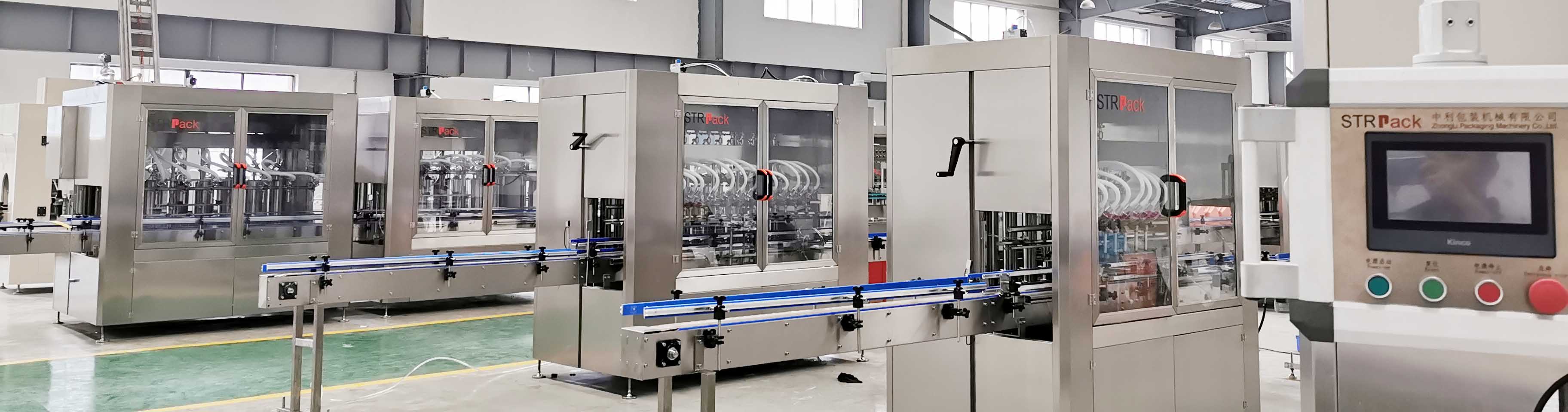
Selecting a filling machine is about more than achieving a target number of bottles per minute. Manufacturers must consider liquid properties, filling accuracy, container formats, cleaning requirements, and the way equipment fits into the wider packaging line. A machine that works well for a free-flowing liquid may not be the best solution for a thicker formulation or a product that creates foam during filling.
For food and beverage producers, personal care brands, household chemical manufacturers, and industrial liquid suppliers, choosing the right filling technology can help improve production consistency and reduce avoidable waste.
Two options worth evaluating are an automatic gear pump filling machine and a high-speed rotary liquid filling machine. Although both are used in liquid packaging, they address different equipment-selection priorities. Gear pump systems focus on controlled liquid transfer and metering, while rotary filling systems use a rotating container-handling arrangement to support production throughput.
This guide explains how these technologies work, where they may fit, and what buyers should evaluate before investing in industrial liquid filling equipment. It also introduces relevant solutions available from STRPACK.
Liquid manufacturers increasingly need equipment that balances production efficiency with consistent product presentation and flexible packaging operations. A single facility may handle several formulations, different bottle sizes, and multiple product categories. These requirements make it important to assess the complete filling process rather than choosing equipment based on speed alone. Three considerations deserve particular attention:
Viscosity affects how easily a liquid moves through pipes, pumps, and filling nozzles. Water-like liquids behave differently from lubricating oils, honey, shampoo, or concentrated detergents. Foaming tendency, temperature sensitivity, and chemical compatibility can also affect the filling process.
For example, a cleaning solution that produces excessive foam may require a different nozzle arrangement or filling strategy from a lubricant with a relatively stable flow. Understanding these differences helps manufacturers narrow down suitable filling technologies before comparing machine specifications.
A manufacturer's required output is not simply the highest advertised machine speed. Actual performance depends on fill volume, bottle dimensions, product behavior, changeover frequency, and downstream operations such as capping and labeling.
A high-speed filler may be appropriate for a stable, repetitive production schedule. A manufacturer that frequently switches between products or container formats may place greater value on setup flexibility and straightforward changeovers.
Inconsistent filling can result in product giveaway, underfilled containers, spills, and additional quality checks. Nozzle dripping and difficult product changeovers may also create cleaning work and unnecessary downtime. Equipment should be evaluated according to performance with the actual product, not just general specifications.
An automatic gear pump filling machine uses precision gears to move and meter liquid into containers. As the gears rotate, they transport liquid through the pump, allowing the filling system to tightly control product flow and volume delivery.
The rotating gears carry liquid from the inlet toward the outlet. Servo-driven control systems allow operators to precisely regulate pump speed and delivery profiles according to the product's flow behavior. This provides repeatable dispensing rather than relying solely on gravity or time-pressure methods.
Evaluate product viscosity under actual factory temperatures, verify that all wetted contact parts match product chemistry, and confirm changeover convenience for multiple container sizes.
STRPACK Recommendation: STRPACK's Automatic Gear Pump Filling Machine features servo-motor drive, PLC touchscreen controls, and variable flow profiles tailored for edible oils, lubricants, and personal care liquids.
A high-speed rotary liquid filling machine uses a continuously rotating carousel mechanism to move bottles through consecutive filling stations. This arrangement maximizes container handling efficiency and ensures steady, synchronized production runs.
Bottles enter via infeed starwheels, rotate steadily through the dispensing zone, and exit toward downstream equipment without sudden start-stop conveyor movement. This is ideal for plants running high, sustained output with consistent container formats.
STRPACK Recommendation: STRPACK's High-speed Rotary Liquid Filling Machine offers customizable options such as bottom-up diving nozzles for foaming liquids and explosion-proof execution for volatile products.
A gear pump refers to the metering mechanism, whereas rotary refers to the container handling system. A rotary machine can even integrate pump-based filling. Use this comparison to align your requirements:
| Selection Factor | Automatic Gear Pump Machine | High-Speed Rotary Machine |
|---|---|---|
| Primary Focus | Controlled liquid transfer & dosing accuracy | Continuous bottle handling & high output |
| Filling Technology | Positive displacement gear pump | Pump, volumetric piston, time-pressure, or flowmeter |
| Ideal Environment | Versatile batch sizes & multiple product switches | High-volume, standardized production lines |
| Purchasing Approach | Match pump materials & controls to formulation | Match rotary speed & integration to line capacity |
A gear pump filler meters fluid using positive displacement gears, whereas a rotary filler handles bottles using a continuous rotating carousel. They address metering and handling respectively.
Gear pump and positive-displacement piston systems are typically well-suited for moderate to high viscosities, provided the fluid is non-abrasive and free of oversized solids.
Yes, as long as the wetted contact parts and pump seals are chemically compatible and clean-in-place (CIP) or flush cycles are manageable between batches.
Please provide product name and viscosity, target speed (BPM), bottle dimensions and drawing samples, fill volume ranges, and required electrical/sanitary standards.
Whether you need flexible metering with an Automatic Gear Pump Filler or high-speed automation with a Rotary Liquid Filler, STRPACK configures systems tailored to your production goals.
Contact STRPACK Todaytolong baca terus, tetap diposting, berlangganan, dan kami menyambut Anda untuk memberi tahu kami pendapat Anda.